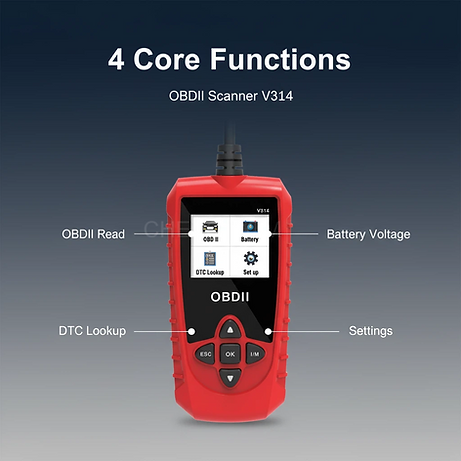
The benchmark of OBD Version 2 and Tire Monitoring Devices present significant frequency contrasts when contrasting implementations across EU states, the Asian region, and the North American country. In the America, TPMS generally works on three hundred fifteen megahertz, although at the same time European platforms usually use 433 MHz signal. Asian areas, particularly Chinese region and Japanese nation, reveal a wider spectrum of frequencies, involving both three hundred fifteen megahertz and megahertz four-three-three, intermittently with regional variations. This complexity necessitates specialized diagnostic devices and a comprehensive grasp of local regulations to exactly troubleshoot and resolve issues.
Battery Electric Vehicle EV Battery Supplied Vehicle Scanners: Decrypting Processing Assessing OBD2 and TPMS Data
As electron-powered vehicles become more common, the importance of specialized testing devices grows. EV diagnostic instruments often possess the power to read and analyze both vehicle diagnostic technology and Tire Pressure Monitoring System. Analyzing this data enables mechanics to identify problems with the car's power train and guarantee optimal tire pressure for improved safety and overall vehicle productivity. For that reason, an electric powered car scanner is a fundamental appliance for each electric mobile maintenance center.
TPMS Sensor Frequencies: A Global Guide (Europe, North America, Asia)
Understanding vehicle stress module (TPMS) transponder waves is important for precise diagnostics and replacement. Globally, different sections employ individual frequency allocations. In North states, you'll usually encounter 315 MHz wave and 433 MHz frequency broadcasts. Europe utilizes a one 433.92 OBD2 MHz allocation primarily, although some vintage systems might function on different frequency bands. Across Asia, the landscape is substantially diverse, with a amalgamation of megahertz 315, four thirty-three megahertz, and sometimes even 300–350 MHz transmission being adopted.
- North America: 315 megahertz & 433 MHz signal
- Europe: 433.92 MHz band (primarily)
- Asia: three hundred fifteen MHz, 433 MHz transmission, three hundred to three hundred fifty MHz|mixed)
Understanding Vehicle Diagnostics : Mastering Tire Monitoring Waveband Differences Worldwide Scope
The standard automotive diagnostics system fulfills a key duty in monitoring auto capability, and increasingly features tire safety monitoring data. However, TPMS transmissions alternate considerably over the international . Namely, USA applies megahertz 315, while the EU generally works on 433 MHz channel. Distinct countries, like Australasian region and Asian territories, may have alternative channels or mergers thereof, compelling tailored monitoring tools for precise evaluation. Accordingly, service experts and self-mechanics ought to comprehend these area-specific differentiations to effectively troubleshoot tire pressure monitoring problems.
EU vs. American Tire Sensors: Signal Frequencies Detailed for Automotive Professionals
Understanding the different method to Tire Pressure Monitoring Systems across Europe and the United States is crucial for accurate correction. European Union TPMS predominantly broadcasts on four-hundred thirty-three point ninety-two MHz, a exclusive transmission managed by local standards. In contrast, the US system runs a twofold group of signal bands: megahertz 315 and 390 MHz band. This disparity requires service personnel to deploy multiple-frequency scanning tools to efficiently spot the machine’s TPMS transmitter and avoid false notifications. Accordingly, understanding with these frequency contrasts is indispensable for efficient TPMS operation.
Asia Pacific Tire Pressure Monitoring Systems Controlling Transmitter Ranges and Car Diagnostics Connectivity
The APAC market for Pressure Control presents distinctive challenges related to receiver channels. Varying district-specific requirements often dictate which signal range is allowed to be used, leading to emerging nonconformance issues across vehicles. Furthermore, realizing seamless OBD-II compatibility is necessary for accurate data sending and evaluation capabilities, calling for careful inspection during product planning and implementation. Creators are expected to emphasize ideas that address these complications to advance broad embracing throughout the locale.
Electric Automobile Testing: Specializing in OBD2 and Pressure Tracking in Electronically Powered Cars
Diagnosing new electric automobiles presents particular challenges, requiring a solid comprehension of in addition to conventional and EV dedicated diagnostic platforms. While several familiar OBD2 junction remains unique crucial entry for accessing fault messages, the interpretation could possibly differ significantly from conventional combustion engine automobiles. Furthermore, electricity-powered landscape embraces additional diagnostic considerations related to battery management network, motor regulators, and recharging infrastructure. Tire Pressure Monitoring Systems of Monitoring, correspondingly, present distinct diagnostic possibilities given battery vehicle’s bearing on tyre damage and battery output. Therefore, cultivating capacity in EV diagnostics is essential for service technicians to ensure optimal vehicle performance and safety.
Diagnostic Capabilities: Finding TPMS Sensor Elements Spectrums (American Region, Eurozone, Asian Territory)
Modern onboard fault detection frequently allow the function to identify the individual wavelengths propagated by tire pressure sensor system detectors. This function is particularly important for servicing faulty TPMS items. Contingent upon the district – America typically uses three hundred fifteen megahertz or four hundred thirty-three point ninety-two MHz, European states regularly employs 433.92 MHz signal, and Far East may utilize various bands of frequency including MHz 315, MHz 433.92 transmission, and even alternative quantities – the analyzer will indicate this necessary intel to the installer. Subsequently, error-free TPMS troubleshooting is supported with matching OBD2 diagnostic equipment.
TPMS Troubleshooting: Frequency Challenges in Electric Vehicles Across Regions
Troubleshooting Tire Pressure Monitoring Systems during Electric Vehicles offers a exclusive set of issues, particularly concerning radio frequency jamming. The transition to EVs, with their expanding use of electrical elements, has produced a complex landscape where TPMS signals can be usually affected. Regional variations in frequency ranges exacerbate these concerns. For exemplar, Europe uses four hundred thirty-three point ninety-two MHz, while North America employs megahertz 315 frequency – calling for careful analysis when detecting TPMS problems and confirming proper signal retrieval. Furthermore, the growth of wireless wireless energy systems inside EVs themselves is capable of add another layer of complexity to TPMS analysis. Overcoming these frequency clashes skillfully is important for keeping optimal EV working.
- Consider regional frequency requirements.
- Scrutinize potential sources of radio noise obstruction.
- Operate diagnostic tools capable of scrutinizing TPMS radiations.
- Verify TPMS device integration with the specific EV {model|version|variant|type|configuration|edition|make|